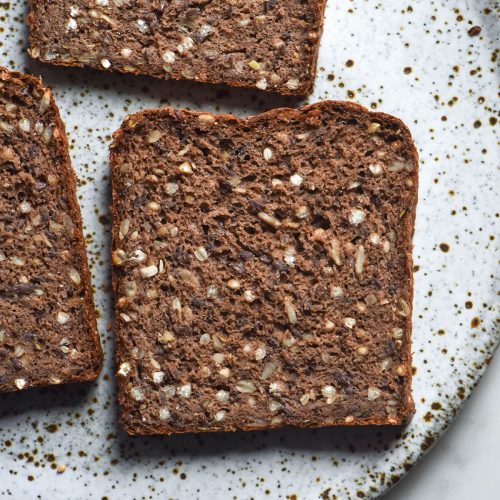
Gluten free rye bread (Danish style)
Gluten free, dairy free, egg free, vegan, xanthan gum free
Equipment
- USA Pan Pullman steel loaf tin - 23cm length X 10cm width X 10cm height or 9 X 4 X 4 inches
Ingredients
For the overnight seed soak:
- 125 g buckwheat groats
- 125 g sunflower seeds
- 100 g whole flaxseeds
- 500 g water
For the gluten free rye bread:
- 300 g light buckwheat flour see notes
- 100 g tapioca flour
- 10 g Dutch processed cocoa
- 20 g psyllium husk powder see notes
- 12-15 g fine salt I used table salt
- 7.5 g instant yeast
- 10-15 caraway seeds ground (optional)
- 40 ml (2 tablespoons)* neutral oil of choice
- 20 ml (1 tablespoon)* maple syrup or sweetener of choice
- 20 ml (1 tablespoon)* molasses
- 125-225 g water see hydration notes in body of post
Instructions
To make the seed soak:
- The night before you intend to bake, prepare the seed soak by combining the ingredients in a medium bowl. Cover and place in the fridge. They don’t need to be used first thing in the morning, but it is important to leave them at least overnight so that the buckwheat groats have time to soften.
The next day:
- Combine the dry ingredients in a large mixing bowl. Add the seed soak, oil, maple syrup and molasses. Stir thoroughly to combine – adequately stirring here will give you a better sense of how much water you need to add.
- Add the water conservatively – 100-150g to start. Mix really thoroughly until there is no dry flour left in the bowl. The mixture should be quite stiff compared to my regular gluten free doughs, but still totally hydrated and sticky. Cover the bowl for 10 minutes.
- After the 10 minutes, assess the dough. If it feels extremely stiff and hard to move around the bowl, add 50g extra water. If it feels firm but too sticky to handle, proceed to the next step. The absolute perfect hydration will depend a little on your ideal style of bread: use slightly less water for a denser, drier style of rye and slightly more for a loftier loaf.
- Grease your 23cm length X 10cm width X 10cm height or 9 X 4 X 4 inches Pullman pan. Use a silicon spatula to encourage the dough into the pan (it will be too thick to pour) and use a wet hand to smooth down the top of the bread. Cover the loaf in an airtight manner. Air will harden the crust of the bread as it proofs which means it will be unable to proof upward, so make sure it is airtight. I use an inverted plastic produce bag secured with a rubber band – it is airtight but leaves plenty of space for the bread to proof upwards.
- Proof the bread in a warm spot for 1-2 hours. It should just reach the edges of the Pullman pan. This will take longer in winter and less time in summer or humid climates.
- While you'e waiting, preheat your oven to 200C/400F. When the bread has proofed, remove the proofing covering and place it in the oven for 1 hour.
- After this time, the bread should be lightly golden and firm on top. Remove it from the oven and invert it (crust side down) onto a wire cooling rack for 5 minutes. This helps eliminate any dense and wet bread bottom issues. After 5 minutes, flip the bread back upwards on the cooling rack and allow to cool completely.
- This bread keeps well stored cut side down on a wooden cutting board for a day or two, but then is best frozen and used as toast.
- To freeze, slice the bread and arrange it on a large lined tray. Freeze for 2-3 hours or until solid, then transfer the frozen slices to an airtight container.
Notes
- See the hydration notes in the body of the post before you start.
- I have only tested light buckwheat flour in this recipe.
- I grind whole psyllium husks to a powder in my spice grinder. I find the store bought powder clumps together too easily so I prefer grinding my own.
Tried this recipe?Let us know how it was!